Creating Durable, Professional Books

Producing a high-quality school book requires more than simply printing pages and binding them together. The right combination of paper, cover material, printing specifications, and binding method ensures a book that is durable, easy to read, and visually professional.
This production guide outlines the recommended specifications for a standard educational textbook, designed to deliver excellent readability, longevity, and print quality.
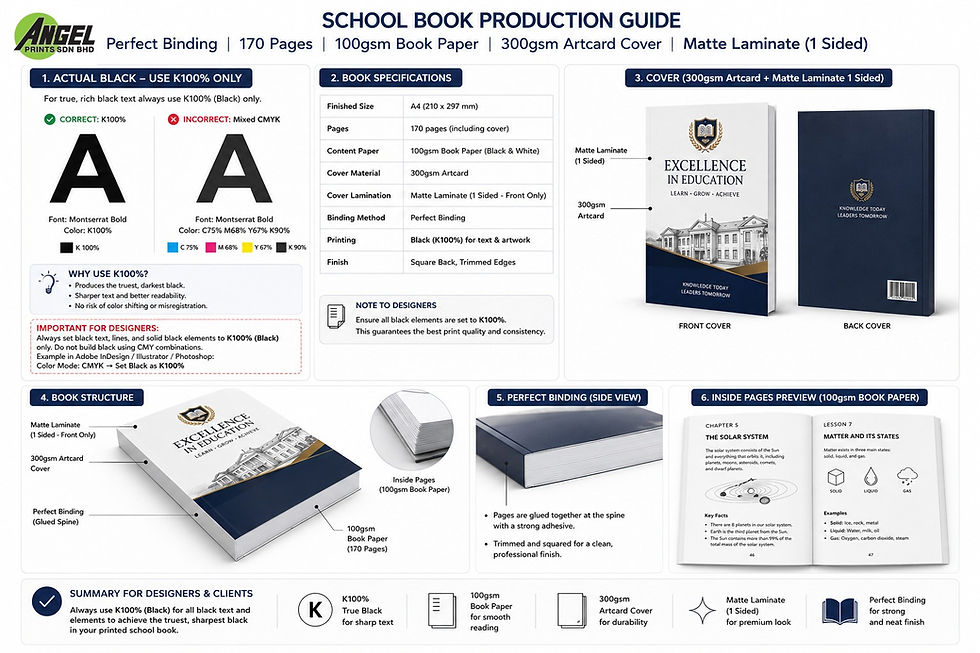
Why K100% Black Matters
One of the most important design considerations when preparing a school book for print is the proper use of black ink.
Use K100% Only for Text
All black text, lines, and solid black elements should be created using K100% (Black Only) rather than a mixed CMYK black.
Correct Method
K = 100%
C = 0%
M = 0%
Y = 0%
Incorrect Method
Using a combination such as:
C75%
M68%
Y67%
K90%
may appear darker on screen but can cause printing issues.
Benefits of K100% Black
✔ Produces a true, rich black appearance.
✔ Ensures sharper text and better readability.
✔ Prevents color shifting during printing.
✔ Eliminates registration problems that can cause blurry text.
✔ Delivers consistent results throughout the print run.
Designer's Note
When preparing artwork in Adobe InDesign, Illustrator, or Photoshop, always ensure black text and line work are set to K100% only in CMYK mode.
Book Specifications
This school book is produced using specifications that balance durability, readability, and cost-effectiveness.
Specification | Details |
Finished Size | A4 (210mm × 297mm) |
Total Pages | 170 Pages (Including Cover) |
Inside Paper | 100gsm Book Paper |
Cover Material | 300gsm Artcard |
Cover Finish | Matte Laminate (Front Only) |
Binding Method | Perfect Binding |
Printing (for fonts typeface) | Black (K100%) |
Finish | Trim to Size |
Premium Cover Construction
The cover serves as the first impression of any educational publication.
Cover Material
The book uses 300gsm Artcard, providing:
Excellent durability
Strong structural support
Professional appearance
Better protection for inside pages
Matte Lamination (1 Side)
A matte laminate is applied to the front cover to enhance both appearance and durability.
Benefits of Matte Lamination
✔ Smooth, premium finish.
✔ Reduces glare and reflections.
✔ Improves resistance to scratches and scuff marks.
✔ Creates a more professional look.
✔ Extends the lifespan of the cover.
Understanding the Book Structure
The book consists of three key components:
1. Matte Laminated Cover
Provides protection while enhancing visual appeal.
2. 300gsm Artcard Cover
Acts as a durable outer shell.
3. 100gsm Book Paper Content Pages
Offers comfortable reading and page-turning performance while maintaining a professional feel.
With 170 pages printed on 100gsm book paper, the publication achieves an ideal balance between thickness and usability.
Perfect Binding: The Professional Choice
The book is bound using Perfect Binding, one of the most popular methods for textbooks, manuals, and educational publications.
How Perfect Binding Works
The inside pages are gathered together and glued securely at the spine using a strong adhesive.
The book block is then attached to the cover and trimmed to create clean, square edges.
Advantages of Perfect Binding
✔ Strong and durable spine.
✔ Professional bookstore-quality appearance.
✔ Flat and neat edges.
✔ Suitable for medium to high page counts.
✔ Ideal for school books, training manuals, and reference materials.
Inside Pages: Optimized for Reading
The internal pages are printed on 100gsm Book Paper, which offers several advantages:
Benefits
✔ Smooth reading experience.
✔ Reduced show-through from the opposite side of the page.
✔ Good opacity for black-and-white printing.
✔ Comfortable weight for students.
✔ Cost-effective for educational publications.
The paper is particularly suitable for textbooks containing text, diagrams, exercises, and educational illustrations.
Best Practices for Designers
To ensure optimal print quality, designers should follow these recommendations:
DO
✔ Use K100% black for all text and line artwork.
✔ Supply artwork in CMYK format and covert to PDF (high resolution printing)
✔ Use high-resolution images.
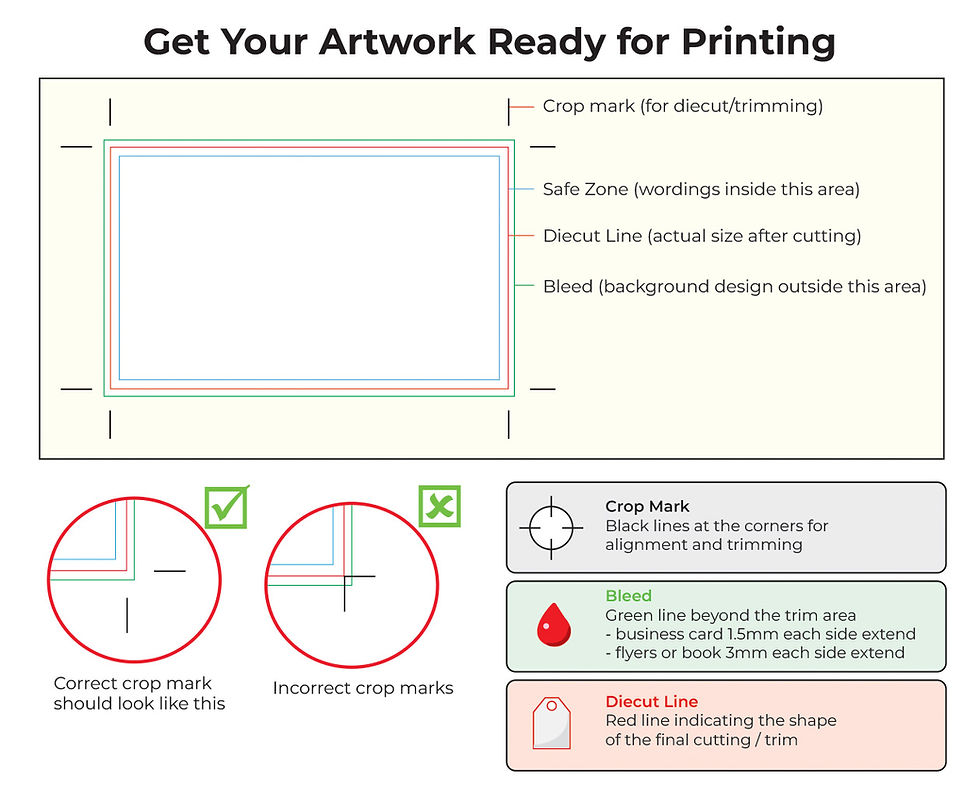
✔ Make sure you provide 3mm bleed each side. Once printed we will cut to size.
✔ Allow adequate margins for perfect binding.
✔ Convert fonts to outlines or embed fonts when supplying PDFs.
✔ Check page numbering and pagination carefully.
DON'T
✘ Use mixed CMYK black for body text.
✘ Place critical information too close to the spine.
✘ Use low-resolution images.
✘ Depend on RGB artwork for print production.
✘ Ignore bleed and trim requirements.
Summary
A professionally produced school book depends on the correct combination of materials and print specifications:
K100% Black for sharp, consistent text.
100gsm Book Paper for comfortable reading.
300gsm Artcard Cover for durability.
Bleed the artwork for trimming. If your artwork has full page color, make sure it has enough bleed for trimming.
Matte Lamination for a premium appearance.
Perfect Binding for strength and a clean finish.
By following these guidelines, schools, publishers, and designers can create educational books that not only look professional but also withstand everyday classroom use while providing an excellent reading experience for students.


Comments